

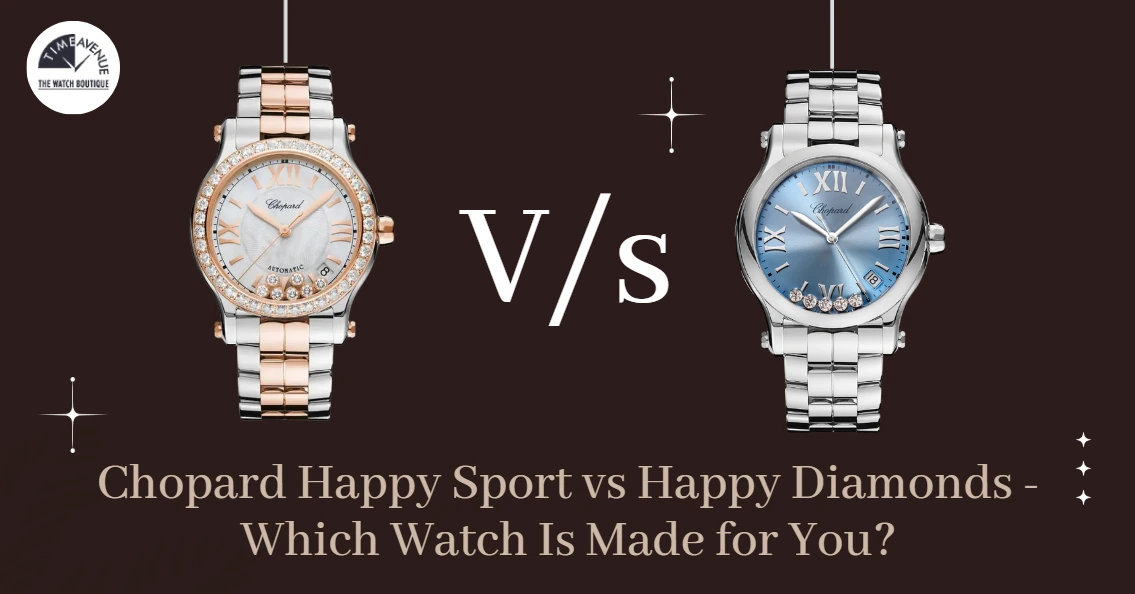
There’s a question that comes up more than you’d expect among women considering Chopard for the first time: Happy Sport or Happy Diamonds? On the surface they look related; both have diamonds that float freely behind the dial, and both come from the same Maison. Both carry that unmistakable sense of jewellery and watchmaking, refusing to choose between each other. But spend time with both collections, and the differences become very clear. Chopard Happy Sport vs Happy Diamonds is really a question about how you live, and where the watch is going with you.
Where the Chopard Happy Diamonds Dancing Diamond Was Born?
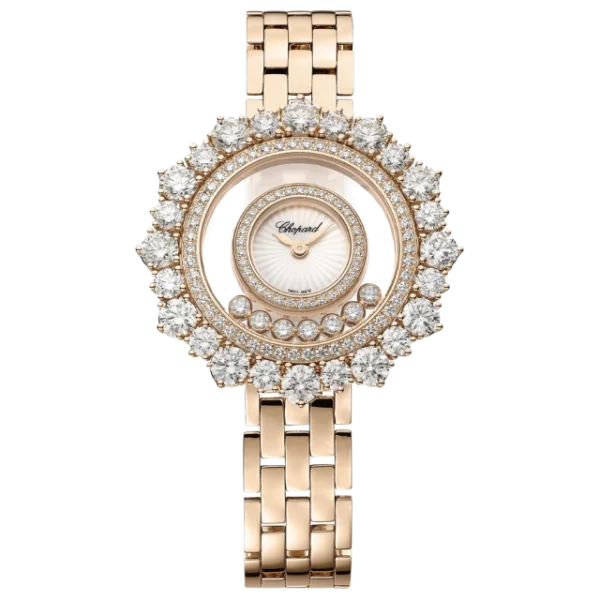
The story starts in 1976, with a designer named Ronald Kurowski on a walk through the Black Forest. He stopped at a waterfall and watched how sunlight hit the water thousands of droplets each catching the light for a moment, none of them fixed, all of them brilliant. He went back to the atelier and asked a simple question: could you do that with diamonds?
It turned out you could, but only if you freed them. Kurowski’s solution was to set each stone in a gold bezel with a bevelled base shaped like a spinning top and sandwich it between two sapphire crystals. With no fixed mounting point, the diamond could spin and glide with every movement of the wrist. The Happy Diamonds concept was born from that single observation.
The first piece was actually a men’s watch – a gold tonneau-shaped timepiece that launched to immediate acclaim and won the Golden Rose of Baden-Baden. It wasn’t until Caroline Scheufele, who later became Artistic Director and Co-President of Chopard, took hold of the idea that it found its way into jewellery (1985) and eventually into what became the Happy Sport. But the founding idea – diamonds are happiest when free, never changed.
How the Chopard Happy Sport Came to Combine Diamonds with Steel?
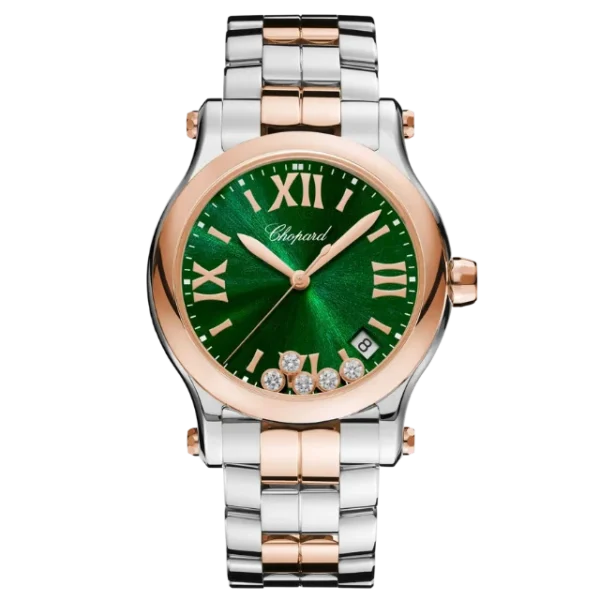
Caroline Scheufele had a practical problem. She wanted a watch she could wear all day through a tennis match in the morning, through meetings, through dinner without taking it off. The Happy Diamonds, beautiful as it was, wasn’t built for that. And the sporty watches of the time had no sparkle at all.
Her idea was to put the dancing diamonds of the Happy Diamonds onto a steel sports watch. The workshop manager told her it was impossible. Steel and diamonds simply weren’t done together. He was so confident she was wrong that he bet her a rose for every watch she sold.
The Happy Sport launched in 1993. It was the first watch in history to combine diamonds with a stainless steel case. The press loved it. Women bought it. By the time it had settled into an icon, the workshop manager owed Caroline Scheufele a rosebush, and he delivered one.
What made it different from its predecessor wasn’t just the steel. The diamonds in the Happy Sport were free to move across the entire open dial, not confined to two concentric rings as in the Happy Diamonds. That small change in choreography gave the collection a completely different spirit. Twenty-five years later, Chopard marked the anniversary by equipping select Happy Sport models with the Calibre 09.01-C — the first in-house ladies’ movement the Maison had ever made. That wasn’t a minor upgrade. It was Chopard making a point about how seriously they took this watch.
How the Dancing Diamonds Actually Move and Why It Matters?
Both collections share the same basic principle. Each diamond sits in a gold bezel with a bevelled base, placed between two sapphire crystals, free to spin and catch the light as the wearer moves. If you’ve never seen it in person, it’s genuinely surprising. There’s something almost illogical about diamonds gliding freely across a dial rather than sitting fixed in their settings.
The difference between the two collections is in the choreography.
In the Happy Diamonds, the stones dance along two concentric rings. The path is defined, the movement composed. It reads as jewellery, which is exactly what it’s meant to be. In the Happy Sport, there are no rings – the diamonds are free to go wherever they like across the full dial. The movement is less predictable, more energetic, and closer to how diamonds would move if no one had told them to behave.
There’s something else worth knowing. Small variables, the distance between the sapphire crystals, the exact profile of each stone’s setting, produce real differences in how the diamonds move between specific references. In some Happy Sport models, they move freely enough that you can hear them: a faint jostling. Reviewers who have handled both collections note this as an intentional quality of the wearing experience, not a defect. Whether you find that appealing or not probably tells you something about which collection is right for you.
The Key Differences of Chopard Happy Sport vs Happy Diamonds
Design and Aesthetic Character
Happy Diamonds is gold only 18k rose or white, no exceptions. Dials are typically mother-of-pearl or classic white. Designed as a dress piece, and it looks like one. Understated, refined, unambiguously formal.
The Happy Sport covers considerably more ground. Cases come in Chopard’s proprietary Lucent Steel, two-tone combinations of Lucent Steel with ethical rose or white gold, and full gold for the haute joaillerie editions. Dial options run from guilloché white to coloured references in midnight blue, turquoise, and salmon. There are Métiers d’Arts editions with hand-painted dials, special editions with floating celestial motifs, and an oval case format — the Happy Sport Oval — alongside the standard round. If variety matters to you, the Happy Sport has it in a way the Happy Diamonds doesn’t try to match.
Movements and Calibres
Both collections offer quartz and automatic references which movement a specific watch carries depends on the reference, not the collection name.
The calibre worth understanding is the Chopard 09.01-C: 148 components, self-winding, 3.5Hz, 42-hour power reserve, developed and produced entirely at Chopard’s manufacture in Fleurier — fitted primarily in Happy Sport references and visible through the sapphire caseback. Genuine in-house movements in women’s watches at this price point are unusual — most comparable watches run on supplied calibres. Chopard chose to build their own specifically for a women’s collection, and that’s worth knowing before you decide.
Happy Diamonds models typically run on ETA quartz movements, with select references offering automatic variants and complications including small seconds, date displays, and power reserve indicators.
Case Materials, Sizing and the Lucent Steel Distinction
Happy Sport steel models use Chopard Lucent Steel, a proprietary alloy made from at least 80% recycled material, 50% harder than standard steel, and anti-allergenic. Every Happy Sport steel case and bracelet uses it. Chopard developed Lucent Steel as part of its commitment to responsible sourcing; the Maison has used 100% ethically produced gold across all collections since 2018.
Happy Diamonds has no steel option. Gold only, which makes the entry investment higher across equivalent sizes, and the material choice more limited by design.
On sizing, both collections run closely parallel: Happy Sport from 25mm to 38mm, plus the oval at 29x31mm; Happy Diamonds from 26mm to 38mm.
Occasions and Wearability
The Happy Sport was designed for twenty-four-hour wear. Thirty metres of water resistance, a comfortable integrated bracelet, and a case built for movement. It accompanies a full day without asking anything of the wearer, which was precisely Caroline Scheufele’s intention from the beginning.
Happy Diamonds asks more of the occasion. It’s at its best at formal dinners, evening events, or any moment where you want a watch that reads as jewellery first. The all-gold construction feels heavier on the wrist, more ceremonial. You wear it deliberately.
One isn’t better. They’re answering different questions.
| Happy Sport | Happy Diamonds | |
| Design character | Sporty-chic; versatile across occasions | Refined jewellery; formal and composed |
| Movement | Chopard 09.01-C in-house (select); quartz | ETA quartz; automatic (select) |
| Case material | Lucent Steel; two-tone; full gold | 18k rose or white gold only |
| Size range | 25–38mm; oval 29×31mm | 26–38mm |
| Best for | All-day wear; varied occasions | Formal events; dress occasions |
Which Chopard Watch Is Right for You?
Honestly, the question isn’t which one is better. It’s which one fits the life you’re actually living.
If you want a watch you can wear every day without thinking about it, something with proper engineering underneath and enough variety to work across occasions, the Happy Sport answers that. If you’re after something you bring out for the moments that matter, something that sits heavier on the wrist and reads unmistakably as jewellery, the Happy Diamonds does that better than almost anything else in its category.
A lot of serious collectors end up with both. Not because they couldn’t decide, but because the two collections genuinely do different things. The dancing diamonds are the same idea. The watches they inhabit are not.
Discover Chopard at Time Avenue
Time Avenue has been an authorized Chopard partner in India for over 27 years. India’s connoisseurs have long regarded us as the Luxury Watch Store that brings genuine expertise to every conversation, and our Chopard collection, available at our boutique, reflects that standard. Buyers across India can also explore the full range through our online boutique.
Frequently Asked Questions
What is the difference between Chopard Happy Sport and Happy Diamonds?
Happy Diamonds, launched in 1976, keeps its dancing diamonds within two defined concentric rings a gold-only dress collection, refined and jewellery-first. The Happy Sport, created by Caroline Scheufele in 1993, lets the same diamonds move freely across the full dial and adds steel case options, making it considerably more versatile. The collections share the same founding concept but serve different lifestyles and occasions.
Are the dancing diamonds in the Happy Sport and Happy Diamonds the same?
The principle is the same, each stone sits in a bevelled gold bezel sandwiched between two sapphire crystals. The behaviour differs. In Happy Diamonds, the stones trace two concentric rings in a structured, composed path. In Happy Sport, they move freely across the entire dial. The distance between the crystals and the setting profile also varies by reference, which affects how quickly the diamonds move and, in some models, whether you can hear them.
Which Chopard collection is better for everyday wear?
The Happy Sport, by design. Caroline Scheufele created it specifically for a full day of wear, 30-metre water resistance, Lucent Steel construction, and a practical integrated bracelet, making it comfortable and durable through an active day. Happy Diamonds, with its all-gold case and jewellery-first aesthetic, is better suited to formal occasions than daily use.
Does the Chopard Happy Sport have an in-house movement?
Select models do. The Chopard Calibre 09.01-C is a 148-component in-house automatic movement with a 42-hour power reserve, designed and produced at Chopard’s manufacture in Fleurier. Not every Happy Sport reference carries its quartz variants, which are also available. For women’s watches at this level, an in-house calibre is genuinely uncommon, and worth seeking out if mechanical movements matter to you.
Is the Chopard Happy Diamonds collection available in stainless steel?
No. Happy Diamonds is gold, only 18k rose or white. For the dancing diamond experience in steel, that’s the Happy Sport’s territory. Happy Sport steel cases and bracelets are produced from Lucent Steel, Chopard’s proprietary alloy composed of at least 80% recycled material.